Prisoner's dilemma
The most famous game in the gametheory is for sure the prisoner's dilemma. This game is used as a model for a lot of other games and decisions in economic life.(see the trust example lower)
Two criminals got caught by the police and put in different rooms. The police wants to make them confess and tell them this.
- You confess and your friend doesn't: no time prison
- You deny and your friend confesses: 10 years in prison
- You both confess: 8 years each
- You both deny: 1 year each
This is visualised in the image down here:
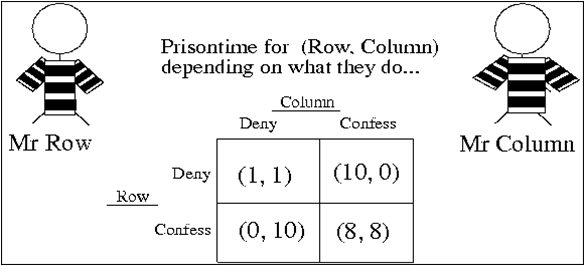
Similar situations in real life have shown that both criminals will usually confess. Even if this isn't the best result in general, it will always get obtained because it is the result of the dominant strategy.
We have a dominant strategy here because whatever the other does, confessing will always end up being the most advantageous. If Mr Row would confess when Mr Column denies the crime then he is free, and if Mr Column confess Mr Row should also confess if he wants to avoid staying 10 years in prison. If you do the thinking process the other way around you get the same solution for Mr Column.
So we can conclude we have a Nash-equilibrium. The Nash-equilibrium is that both of the criminals confess.
Trust-Duopoly
Another application is whether companies should engage in a
trust.
This situation describes two companies in a pay-off matrix. The
decision variable is the amount of units they would produce. Obviously it is
seen from the matrix that is better that they work together and agree to
produce 60 units all together. Since their combined profit is maximised at 3,600. However, if one of them decides to produce 40 units and
the other produces 30 units, because he can obtain a higher profit (2,000 instead of 1,800), their overall profit will be lower.
As such there is an incentive to produce 40 units, in order to gain more
profit. Overall profit would be maximized if both companies agree to produce
only 60 units (30 each).
However there is also an incentive to cheat. When
agreed upon a trust and one company increases its production (in the assumption
that the other company keeps producing the same amount) it will increase profit
by 200 to 2000. Naturally, the other company has the same incentive, so the
Nash equilibrium is set at producing 40 units each.
So yes, it is better to form a trust, but there’s always an incentive to cheat.
|
|
40 units |
30 units |
|
40 units |
1600,1600 |
2000,1400 |
|
30 units |
1400,2000 |
1800,1800 |
Wage Negotiations
In the following, an application of the prisoners dilemma will be discussed. It is about wage negotiations and the possible outcomes when there is no cooperation.
Before the pay-off matrix can be discussed, some assumptions have to be made in order to make a correct evaluation. Wages are negotiated in each sector (e.g.: car industry, tourism, agriculture, and so on), therefore each of the sectors will try to optimize its own profit rather than thinking of the country’s economy (and as such the competitiveness of the country). These assumptions justify the following reasoning. In the payoff matrix, there are two numbers. On the left is the effect of the sector A’s decision which is either ‘0’ (no effect on relative wage), ‘+’ (positive effect on relative wage) and ‘–‘ (negative effect on relative wage). On the right is the effect on society +/++ ((big) positive effect on society) or -/-- ((big) negative effect on society).
|
Sector A |
All of the other sectors |
|
|
Increase in wages |
Decrease in wages |
|
|
Increase in wages |
(0 , --) |
(+ , +) |
|
Decrease in wages |
(- , -) |
(0 , ++) |
We look at this event through the eyes of one sector and the effect of its action on the other sectors. If sector A decides to increase its wages and the other sectors decides the same thing, than there is no effect on relative wages (all of the other sectors will increase too so sector A doesn’t become wealthier). In addition, the employment will decrease because their wages will be relatively higher than other countries. However, if the other sectors decrease their wages, there will be a benefit for sector A (since it will earn more than the other sectors) and the society as a whole will benefit from this (the overall wage level will decrease so the country becomes more competitive).
Sector A decides to decrease its wages and the other sectors make the opposite decision, than the sector won’t benefit (it will become relatively poorer). Society won’t benefit either, because the overall wage level will increase. However, all of the sectors decide to decrease their wages, sector won’t benefit nor loose. Both the economic competiveness will benefit, because all sectors (including sector A) will decrease their wages.
The decision which will be eventually taken by sector A is to increase its wages. Since the outcome for them is always better making this decision. This is a clear application of the prisoners dilemma: the best option for every actor is never taking because both parties cannot work together. The solution is to cooperate and agree not to increase the wages so the competiveness will better. So more job opportunities will be created. This can only be obtained by working together on a national level which can be hard to obtain since it requires changing the entire system.
