Braess’s Paradox occurs in road networks when an additional road is opened to facilitate traffic. Instead of decreasing the travel time, the overall travel time grows. This is due to the Nash equilibrium.
Imagine a road network consisting of two separate roads
(Start-A-End, Start-B-End), for now we ignore the dotted line. The travel time
for both roads is determined by the amount of drivers using it. For the part
Start-A the travel time is the amount of drivers divided by 100. So if 3,000
drivers use this part, the travel time will be 30 minutes per car. The second
part (A-End) takes 45 minutes, the amount of drivers has no effect on travel
time. Same thing for the route Start-B-End. If there are 4,000 drivers, they
will be equally distributed over both routes. The travel time in this scenario
is 65 minutes (2000/100 + 45 = 65 minutes). 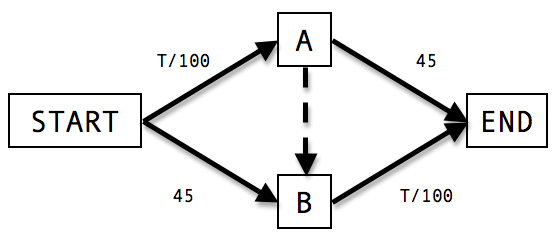
If the dotted line represents a road with travel time approximately zero, the time to get to the end will increase. Because the time to get to A is shorter (4000/100= 40 minutes) than to get to B (45 minutes). Since you can now take A-B so you can take route B-End, you will do this. This is because travel time to get to the end is lower if you take B-End (40 minutes) than A-End (45 minutes). Therefore, everybody will take this route which results in a 80 minutes travel time (15 more than when there was no additional route).
If everybody would agree not to use the route the travel time would be decreased by 15 minutes, however if one person takes the shorter route, he will always benefit a shorter travel time. This is the problem of the free-rider.
