Economic
Here an example of a sequential game that can be used by companies to make decisions.
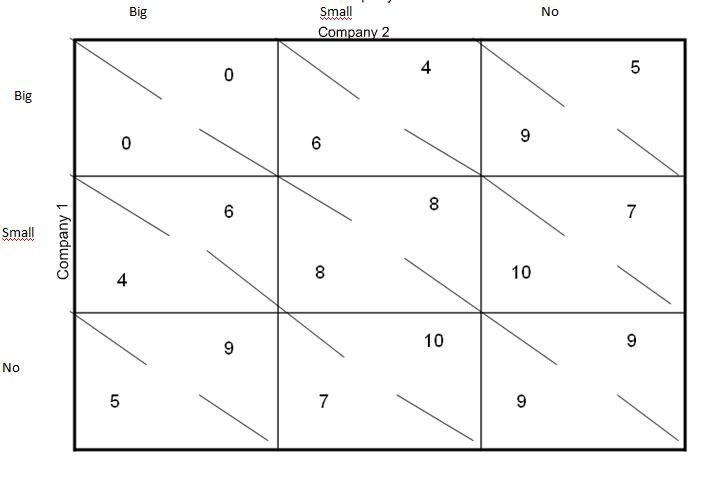
Company 1 knows that she got the approval of the foreign government to build this plant before company 2. She can choose first.
The
manager of the company would like to know which is the best decision
for him, and how his competitor is going to react on his decision.
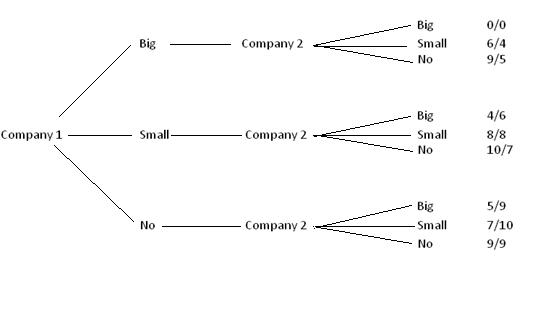
If we assume that company 2 will react rationally on
the action of company 1. We can find easily which is the best decision
to make for company 1. Follow the next thinking process.
If company 1 decides to build a big plant, company 2 will decide not to build because this would give the biggest pay-off: 5 (compare 0 to 4 to 5 in the first branch). The pay-off of company 1 would be 9 in that case.
If company 1 decides to build a small plant, company 2 will decide to build a small one too. This would give a pay-off of 8 to both companies.
If
company 1 decides to not build any plant, company 2 will decice to
build a small plant. Which would give a pay-off of 7 at company 1 and a
pay-off of 10 at company 2.
Maximin theory-Maximax theory
Imagine you want to organize an event to get money for a charity. To win money you will among other things sell hamburgers. The cost of the hamburgers are 1$, the profit for each hamburger is 1.5$. This would be the pay-off matrix.
|
Action: # ordered |
Situation: # sold 50 100 150 |
MIN |
MAX |
|
0 |
0 0 0 |
0 |
0 |
|
50 |
75 75 75 |
75 |
75 |
|
75 |
50 112.5 112.5 |
50 |
112.5 |
|
100 |
25 150 150 |
25 |
150 |
|
150 |
-25 100 225 |
-25 |
225 |
Suppose you have two persons: John and Jack. Jack is more an impulsive person, attracted by big wins and never really thinks about possible losses. John is the opposite he always first think about what can be lost, he is more a pessimistic person.
So Jack wants to
make the biggest profit possible so he decide to use maximax. He looks
for each possible action what the best pay-off is and doesn't care
about the possible situation. He takes the maximum of each row and
looks to the biggest profit. Which is 225$ and a possible loss of 25.
Networks
The internet is a big network of different nodes that is so complex that a regular person cannot fully understand its working. Information is sent through this network at the speed of light, using many different nodes and central nervous centers. Studies have shown that the current use of heuristics is not necessarily the best/most efficient way to send information across the internet.
Nowadays, information is sent using the ‘selfish routing’. This means that every router will try to send information on the data path that costs the least. Once this path congests, another path will be searched for and used until this one is congested itself. Obviously, this is not the best way to send information since it keeps sending information until the path congests so producing delays. This Nash equilibrium results in a more congested network compared to the ideal state.
A way to avoid this issue is to incorporate forward thinking in the router so it doesn’t only chose the one with the lowest cost. Instead it chooses the path which yields the highest social welfare by decreasing your own personal data travel time.
Biology
Some phenomena we encounter in nature can be modeled using game theory.
There is the relationship of the birds called ziczacs and the crocodile’s. The cooperation between both species is one in which the birds eat food out of the mouth of the crocodile. Both animals have positive effects: the crocodile’s mouth is cleansed of parasites and the ziczacs have food to eat. Of course, the crocodile could always eat the bird and as such disturb the equilibrium. However, he would then have to bear the consequences. This is a clear example of an Equilibrium in nature.
Politics
An example of tit-for-tat strategy can be found in war situations. For example in the trenches in World War I soldiers wouldn't attack each other in fear that the others would retaliate. So they first cooperated which is in line with the tit-for-tat strategy. As long as the other didn't attack they didn't either. It was an informal peace. When the generals found out, they tried to convince their men to kill by telling them that killing must be a daily affair. But they weren't actually sure if their soldiers carried out their orders. The British started raiding their ennemy, their soldiers had to bring back prisoners or kill them while trying this. This was for the soldiers an action that convinced them to counter attack. And even if it was not the purpose of the British to break their cooperation, this action made their cooperation collapse.
Sports
Ignacio Palacio-Huerta analyzed sport situations where game-theories are used.
Penalties in soccer game were for him one of the clearest situation with game theory. Its a real happening zero sum game between two persons. The keeper and the player. They can both win 1 or lose one, so the result will always be zero and there will always be a winner and a loser. It a static game because both players have to take a decision on the same moment. Lets assume the players can choose 2sides, right or left (in reallife also central and next of the goal) and this of course without knowing what the other is going to do. They both will try to take their best side. Ofcourse they can't do it every single time or the keeper will take the same side and the player the opposite side. Each player has to decide how frequently he chooses which side, to maximize his payoff. They have to act in accordance to the Minimax theory so that their payoff would be the same for the right or the left side; and it should be unpredictable if the player is going to choose right or left.
He analyzed a lot of players in big leagues in Europe and found out that the top players were really good game theorists.
source: http://www.gelfmagazine.com/archives/the_game_theory_of_penalty_kicks.php
